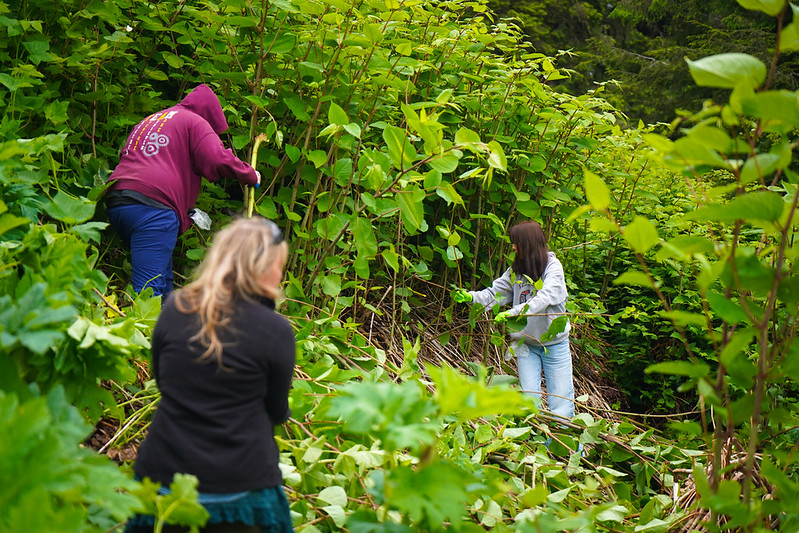
Over summer, five youth crews across Southeast Alaska worked within and for their communities in Angoon, Hoonah, Kake, Prince of Wales Island, and Yakutat on projects ranging from stream restoration to water monitoring to harvesting to gardening. In August, their season concluded by celebrating over 140 projects documented in their annual project map, one of their highest entry numbers yet.
For those who may be unfamiliar, the Alaska Youth Stewards (AYS) program is a workforce development program hosted by Tlingit & Haida that nurtures the next generation of rural and Indigenous community leaders. The AYS program offers youth place-based, on-the-job experiential education and training to care for their home lands, waters, and communities. Each crew’s work season is dynamic and variable, reflecting the priorities and needs of each community while exposing youth to a diversity of career pathways and professional networks.
The AYS program is hosted in partnership with local organizations that include Hoonah Indian Association, Organized Village of Kake, Angoon Community Association, Yakutat Tlingit Tribe, and Craig Tribal Association. Over the years, AYS has been enhanced by extended partnerships with the USDA Forest Service, Sustainable Southeast Partnership/Spruce Root, Sealaska Corporation, The Nature Conservancy, The National Forest Foundation, and more.
This year was full of many accomplishments, memories, and milestones for the program, including onboarding a Yakutat Alaska Youth Stewards crew with Yakutat Tlingit Tribe. Iterations of this program were explored in previous years learning from the work of other communities – it is a huge milestone to officially welcome them to the program.
To commemorate another successful season, we gathered shares from the crew leads of each community on projects they were proud of and why.
All Crew Training
Starting in 2024, the all-crew training is a valuable connection point for the crews across Southeast Alaska as the only in-person time they get to spend with each other as an entire cohort. The training is grounded in cross-learning, collaboration, and relationship building providing program cohesion in shared values and approaches in service to their home communities.
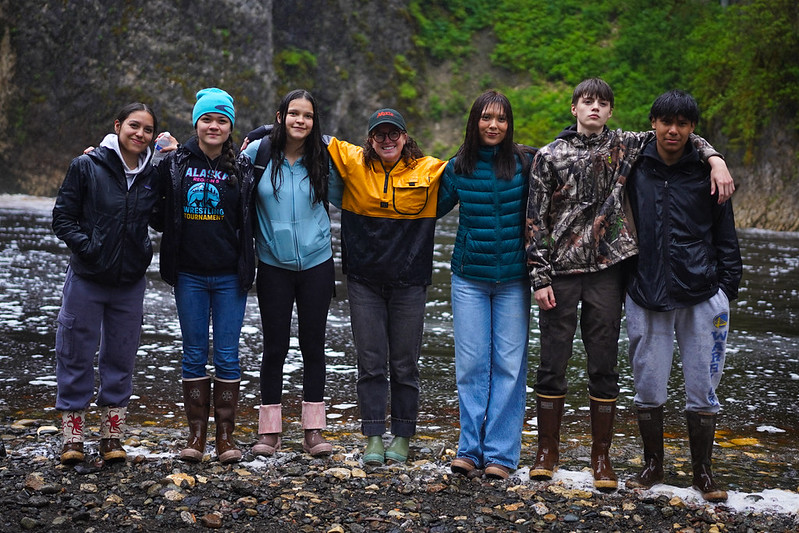
Over the course of seven days, the all-crew training in Kéex’ Kwáan (Kake) brought together 22 crew members, eight crew leaders, one regional coordinator and 10 plus program partners. They did hands-on work with the local Tribe and crew host organization including the Organized Village of Kake’s (OVK) shellfish garden, tannery, and invasive species treatment projects, ending with the youth being certified in wilderness first aid. Some highlights include:
Opening Games: Crews gathered at the local beloved trail Cathedral Falls where they did some team and relationship building games and exercises. Along the way, crews were asked to think about what they would do differently, and if they had leaned on their teammates shared wisdom enough. The goal was to practice clear, intentional, and caring communication while building cross-crew relationships, while immersing in the only downpour of a rather sunny week.
Financial Wellness: “Just because summer has all these things, does it mean we use them in that time?” Haley Armstrong, Spruce Root Financial Wellness Manager
Over two hours, crews explored the seasonality of their lives and how it related to their own financial wellness from managing their summer paychecks to building a retirement plan. Similarly to harvest seasons in Southeast Alaska, crews learned to prepare financially in spring and summer for a busy fall and winter with the school year.
Clam Gardens: “You hear about leaving something for the next generation, this is part of that.” – Justin McDonald, Natural Resources Coordinator
Clam gardens are a traditional marine resource management system that once was integral to the livelihoods of coastal Tribes. They are referred to as “gardens” because they harness natural systems to grow and support shellfish and local ecosystems. These gardens are created by constructing rock walls on the beach to trap silt and create mud flats shellfish can inhabit. On two separate occasions, the crews helped “fluff” and nurture an existing clam garden, and built a rock wall for another.
Organized Village of Kake Sea Otter Tannery: While sea otters are an important part of our ecosystem that help maintain the balance of kelp forests, embayments, and estuaries, large populations can cause imbalance. Documented for centuries, sea otter hunting has been a strategy Indigenous People utilized at small geographic scales around their communities to manage local populations and maintain ecological balance. On a sunny afternoon at the historic cannery, crew members got to learn about OVK’s tannery programming.
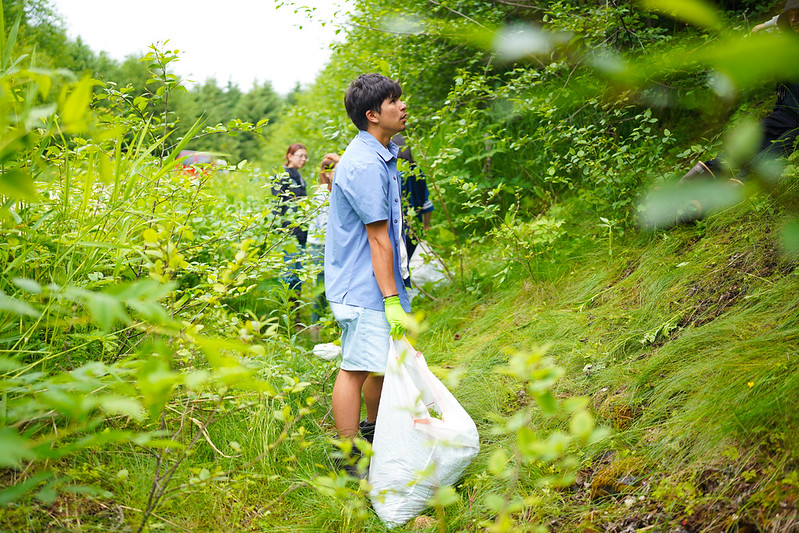
Plant Identification: With the USDA Forest Service, crew members learned how to identify three kinds of invasive plant species before going out into the community to do some maintenance: Herb Robert, Japanese Knotweed, and Sweet Clover.
Wilderness First Aid: Over two and a half days, crew members spent 20 hours getting wilderness first aid certified learning essential skills in patient assessment, trauma and injury care, and how to act in the case of a medical emergency.
Now, let’s see what the crews were up to over summer…
Angoon AYS Coordinator Eric Benedict
Lichen Biomass Sampling
The Angoon Community Association is engaged in a multi-year biomass sampling project in the area around Hawk Inlet. The project is intended to test for fugitive dust contamination from the Greens Creek Mine tailings pile. The Angoon AYS crew (Josh Bowen Jr., Emma Manu Thomas, Jon Lord, Gabrielle Sjoberg, and Eric Benedict) was asked to spend multiple days in the area sampling four lichen species (Witches Hair, Lung, Tube and Rag) and Hudson Bay Tea. Sampling was performed opportunistically at locations chosen by ACA partner Guy Archibald, Mining and Clean Water Coordinator with the Southeast Alaska Conservation Council. With the help of Lead ACA Sampling Technician and Angoon resident Christine Ramey, the crew sampled lichen and tea leaves at 10 sites throughout the area. Samples were sent to a laboratory for analysis, and the results will be included in a season-long summary in the near future.
Lake Kathleen Stream Restoration
The area known locally as “Cube Cove” refers to a large tract of previously clear-cut land that was recently purchased by the USFS and re-integrated into the Kootznoowoo Wilderness. Among the many tasks needed to prevent the continued deterioration of the land and properly “re-wild” the area back to old growth conditions, is stream restoration. This involves adding woody debris in degraded streambeds to create facsimiles of natural features, generating habitat for life up and down the food chain. A healthy streambed creates habitat for insects who in turn provide food for birds in the surrounding thinned forests, and larger aquatic life like the trout and kokanee who will one day swim through the newly formed pools and riffles. This project developed in partnership with Kootznoowoo Inc, United States Forest Service and the Southeast Alaska Watershed Coalition (SAWC). Personnel on this trip included AYS crewmembers Josh Bowen Jr. Emma Bowen, Angel Jack, Jessie Nelson, Emma Manu Thomas, Fredrick Washington, Jon Lord and Eric Benedict, Cameron Ogden of Tlingit and Haida, Carolyn Auwaerter of the National Forest Foundation, and John Hudson of SAWC.
Kake AYS Coordinator, Eloise Peabbles
Grave Island Caretaking
As part of a multi-year collaboration, AYS partnered with the Organized Village of Kake and the USDA Forest Service to caretake Grave Island. I witnessed Izabel, Daniel, Aurora, LilyIda and Erik put immense love and care into their ancestors’ resting places. Grave Island looked like a jungle when we first arrived, and foot by foot, our crew of 10 (including five Forest Service Partners) cleared berry bushes and yanna.eit across the whole island. We uncovered grave stones from thick mats of moss, and welcomed them back to the sunlight. Yak’éi yeeiwsateení – We are happy to see you (again). It was certainly a team effort, and also sets the tone for the work the youth carried out this summer. Haa léelk’u hás tuwáadáx áwé gútk haa jeet kawduwatée – If it wasn’t for our Elders, we wouldn’t be here.
Proxy Sockeye Harvest
Another successful program partnership we had this summer was our Proxy Sockeye Harvest with the USDA Forest Service out of Sitka. We worked with Subsistence Biologist Ashley Bolwerk and her intern Graceann, for our third year running. After learning about ADF&G licenses and permits, and checking in with our Elders on how much fish they wanted, we head off for Falls Creek. We spent our first day setting up camp and dip-netting. The fishing was slow, but Daniel managed to net three sockeye. After deliberation with our Forest Service partners and our local fisherman, we decided to beach seine at a different sockeye run the next day.
We had a restful evening at our campsite in Red Bluff Bay, eating smoked salmon mac n’ cheese and admiring the steep mountainsides around us. Ashley took us on an evening boat cruise further into the bay, in hopes of seeing a brown bear. While no bears showed themselves, we saw some playful seals and a beautiful waterfall.
We arose at 6 AM the next day to pack up our campsite and meet our fisherman, Tim & Russ. When we went to start our boat, only one of our twin motors started. After some troubleshooting, we decided our safety bet was to just head home. It was a good lesson in risk management and safe decision-making. By the time we finished cleaning our camping supplies, Tim called to say they had sockeye for us. We met the two fishermen down at the dock and worked together to gut and process our sockeye haul. We called our Elders and they came down with their coolers. Everyone was so grateful to go home with fish. We had enough sockeye for AYS crew members to bring some home to their families, and we spent the next morning distributing our final fish to Elders who hadn’t received fish yet.
Prince of Wales Island (POW) AYS Coordinator, Spencer Beckman
Invasive European Green Crab Monitoring
POW AYS partnered with Sealaska and Organized Village of Kasaan in monitoring for the presence of invasive European green crab near the community of Kasaan. The crew spent an entire week setting and checking traps, performing carapace surveys along the beaches, and learning about European green crab and the environmental and ecological impacts posed by their presence. Crew members were pleased to find no living specimens, however, many green crab carapaces were found while conducting beach surveys. By better understanding the complicated ecological effects of invasive species, our crew members can develop a sense of ownership in wanting to protect traditional subsistence species such as dungeness crab.
Watershed Monitoring Surveys
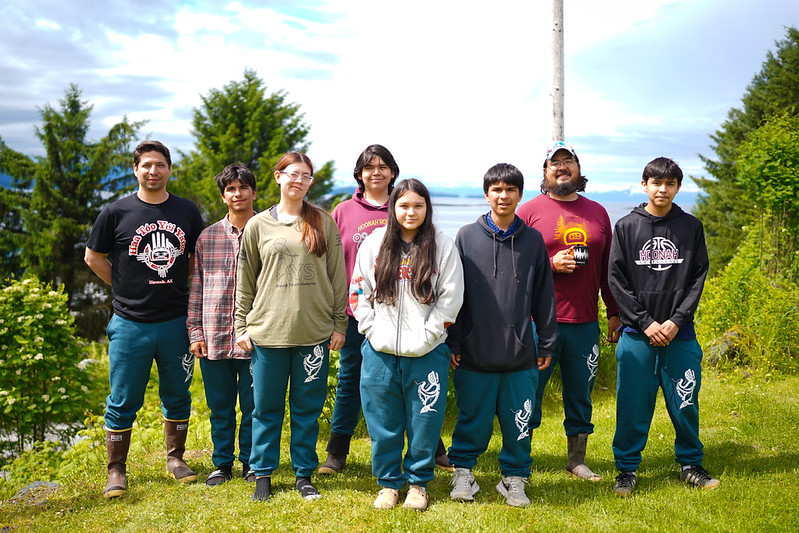
POW AYS also partnered with the USFS in conducting watershed monitoring surveys in the Staney Creek watershed. Crew members participated in the stream surveys gaining hands-on experience while taking vital habitat measurements. Crew members were fortunate to work alongside professionals in the environmental field that taught them how stream research provides beneficial information in monitoring the Staney Creek watershed and other watersheds impacted by historical timber harvest.
Hoonah AYS Coordinator, Julian Narvaez
Hoktaheen Weir Construction
On July 20, after a two year process, including over seven months of permitting, HIA’s Fisheries, AYS, and HNFP (Hoonah Native Forest Partnership) crews worked together to build a remote fish monitoring weir to begin generating current and accurate stock assessments of sockeye.
Despite being a heavily utilized system, critically important to the surrounding communities, no current data exists on this resource. Over 20 years have passed since HIA and the USFS conducted fish counts by foot for three short seasons.
This weir is one of only a handful of tribally operated weirs in the state. From conception, installation, and operation, it is also one of just a few completely unmanned video monitoring weirs, using technology to limit costs. Like our weir in Neva, footage is sent back to Hoonah to be reviewed by our fisheries technicians.
This data will be used in the State and Federal Resource Management processes to protect the health of, and access to our resources.
Spasski Tributary Stream Restoration
The week of July 6, our AYS, Hoonah Native Forest Partnership, Fisheries, and Forest Service crews worked together on this year’s stream restoration project. The work was on Huna Totem Land and is funded in partnership with Southeast Alaska Watershed Coalition. The goal is to make riverways healthier for salmon and to handle high water events better.
Our AYS crew was commended for their hard work and professionalism working alongside their adult counterparts. There was a very deep section that was threatening a nearby culvert, and the crews fixed that by building large structures in the river below the pool and reactivating an old side channel that had filled with sediment. The logs used were large, 16 to 18 inches in diameter and 20 feet long. Thirty of them needed to be hauled from the road to the river, which is no easy feat.
Yakutat AYS Coordinator, Stephen Adams
Bad Day Creek Restoration Project
Bad Day Creek served as the primary environmental restoration project of the 2026 season. AYS participants assisted the U.S. Forest Service, Southeast Alaska Watershed Coalition (SAWC), and Yak-Tat Kwaan in implementing restoration measures intended to improve watershed conditions and support long-term ecological function.
Over the course of the project, the crew contributed to riparian restoration across approximately 0.5 to 1 mile of streambank averaging roughly 6 feet in width — an estimated 15,840 to 31,680 square feet of restored habitat. The crew also conducted two water sampling events over the season.The project was completed ahead of schedule. The final scheduled project day was used to inspect completed restoration structures and verify performance, rather than continuing new construction — a good sign of the work’s pace and quality.
Elder Engagement & Senior Center Partnership
A defining feature of the 2026 season was regular participation at the Yakutat Senior Center — a partnership that grew organically over the course of the season. The goal was to increase meaningful interaction between youth and Elders and create room for mentorship, conversation, storytelling, and relationship-building.
AYS participants played games with Elders, assisted with social activities and Senior Center operations, took part in conversations touching on Traditional Ecological Knowledge, and helped set up and run lunch programs.
Albert Porter Sr., an Elder connected with the Senior Center, described the program as “exactly what the elders need” — a meaningful endorsement of the partnership from within the community it was designed to serve.
Shaelene Grace Moler serves as the Regional Communications Catalyst for the Sustainable Southeast Partnership hosted by Spruce Root. She grew up in Kake, but now lives in Sitka.