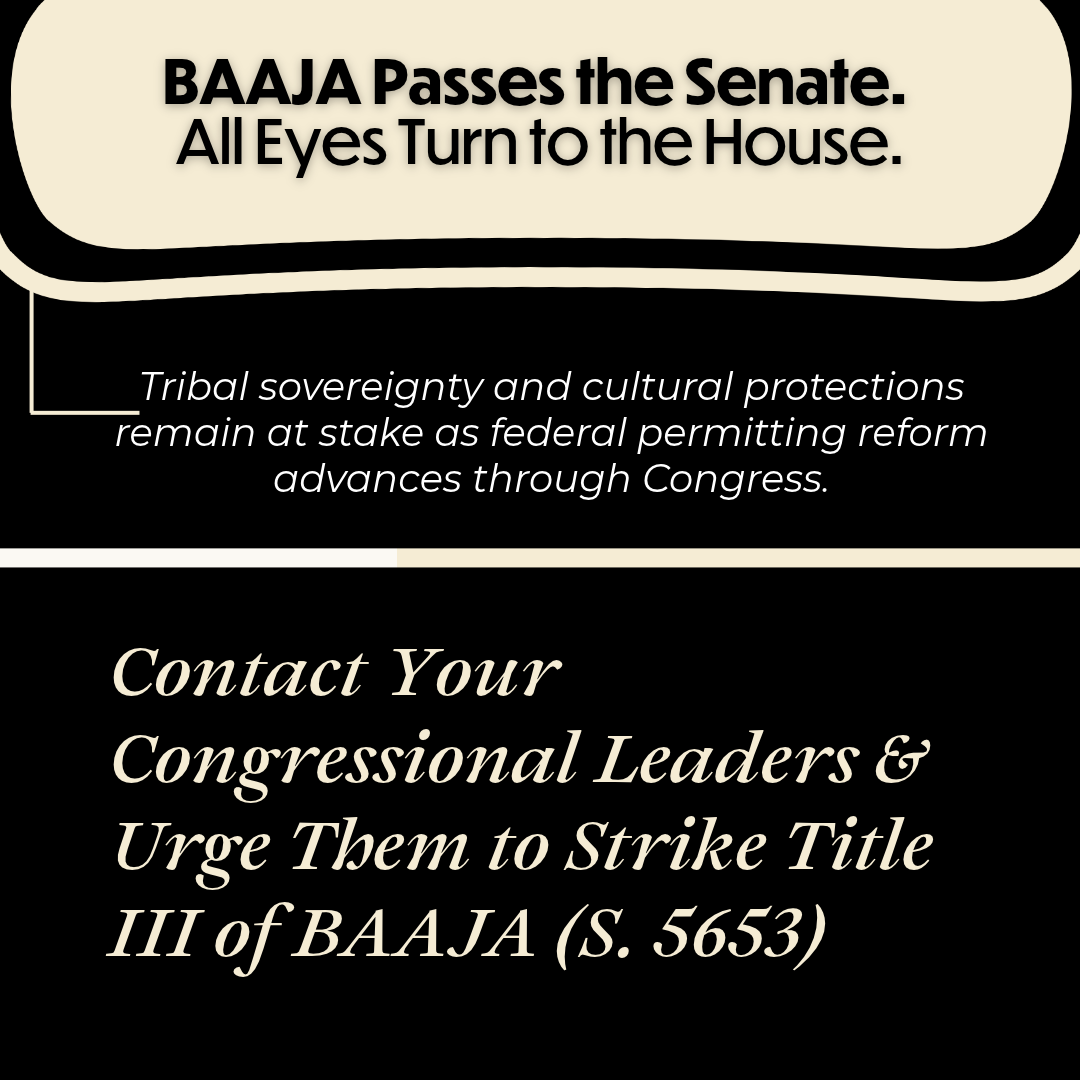
Tribal sovereignty and cultural protections remain at stake as federal permitting reform advances through Congress.
On November 19, 2026, the U.S. Senate passed the Bipartisan American Affordability and Jobs Act of 2026 (BAAJA) by a vote of 62–33, advancing the legislation to the U.S. House of Representatives for consideration following the Thanksgiving recess.
While the legislation is intended to streamline federal permitting, accelerate development and reduce energy costs, it also includes significant changes that threaten Tribal sovereignty and the ability of Tribal Nations to protect their ancestral homelands, cultural resources and waters.
Despite widespread advocacy from Tribal Nations, Tribal organizations and historic preservation advocates, Title III of the legislation remains intact. Although amendments were adopted to address some concerns, significant changes to Section 106 of the National Historic Preservation Act remain in the Senate-passed legislation.
What Remains at Stake
Tlingit & Haida continues to have serious concerns about provisions that would:
- Weaken meaningful Tribal consultation by limiting opportunities for early and substantive government-to-government participation in federal decisions.
- Undermine cultural protections by narrowing the scope of Section 106 reviews, including which projects, cultural places and potential impacts are considered.
- Restrict protections for ancestral homelands by limiting consideration of impacts to culturally significant landscapes, sacred sites and traditional use areas.
- Limit environmental review and federal accountability through shortened review timelines and restrictions on judicial review and available legal remedies.
- Place additional burdens on Tribal Nations by imposing more restrictive timelines and requirements on Tribal historic preservation efforts.
For Alaska Native communities, these changes carry real consequences. Our ancestral homelands, sacred places, burial grounds, traditional harvest areas and cultural landscapes extend across lands and waters managed by federal, state, municipal, corporate and private entities.
Meaningful Tribal consultation is not simply a procedural requirement. It is a critical part of the federal government’s responsibility to Tribal Nations and helps ensure that our cultural heritage, traditional knowledge and ways of life are protected for future generations.
What’s Next?
The legislation now moves to the U.S. House of Representatives, where lawmakers will have an opportunity to consider, amend or reject the legislation.
BAAJA has not yet become law. If the House makes changes to the Senate-passed legislation, it will require further congressional action before it can be sent to the President.
This next legislative phase presents another opportunity for Tribal Nations, Tribal citizens and allies to elevate their concerns and advocate for the protection of Tribal sovereignty.
Resources for Staying Informed
As families and friends gather over the Thanksgiving holiday, it is also an opportunity to discuss issues that will affect our communities and future generations long after the holiday weekend.
Alaska’s representative in the U.S. House is Congressman Nick Begich. Tribal citizens and community members can contact congressional offices to learn more about the legislation, share their perspectives and ask questions about its potential impacts.
Key issues for consideration include:
- The future of Section 106 and historic preservation protections.
- Meaningful, mandatory government-to-government Tribal consultation.
- Protection of sacred sites, cultural landscapes and traditional use areas.
- The relationship between federal permitting reform, Tribal sovereignty and environmental accountability.
Ask Representative Begich and members of the House to:
- Oppose BAAJA as currently written and reject provisions that undermine Tribal sovereignty.
- Protect meaningful, mandatory government-to-government consultation.
- Preserve the ability of Tribal Nations to identify and protect sacred sites, cultural landscapes, and traditional use areas.
- Ensure federal permitting reform does not come at the expense of Tribal rights, environmental protections, and accountability.
The holiday may have a complicated history, but this call to action is straightforward: Tribal sovereignty is not negotiable.
Call the U.S. Capitol Switchboard at 202.224.3121 and ask to be connected to Representative Begich’s office—or contact your own Representative.
Our homelands. Our rights. Our voices. Make the call.
Stay Informed and Engaged
Visit www.house.gov to find your U.S. Representative.
Learn more about Section 106 and the latest legislative developments at protect106.org.
Our homelands. Our cultural heritage. Our future.
Tlingit & Haida remains committed to protecting Tribal sovereignty and preserving our cultural heritage for generations to come.